Murmur
Push-to-talk dictation for macOS using your own OpenAI API key
Claude Code
Create a citizen, offer advice rather than orders, and return to a shared island where memories, relationships and consequences continue in real time.
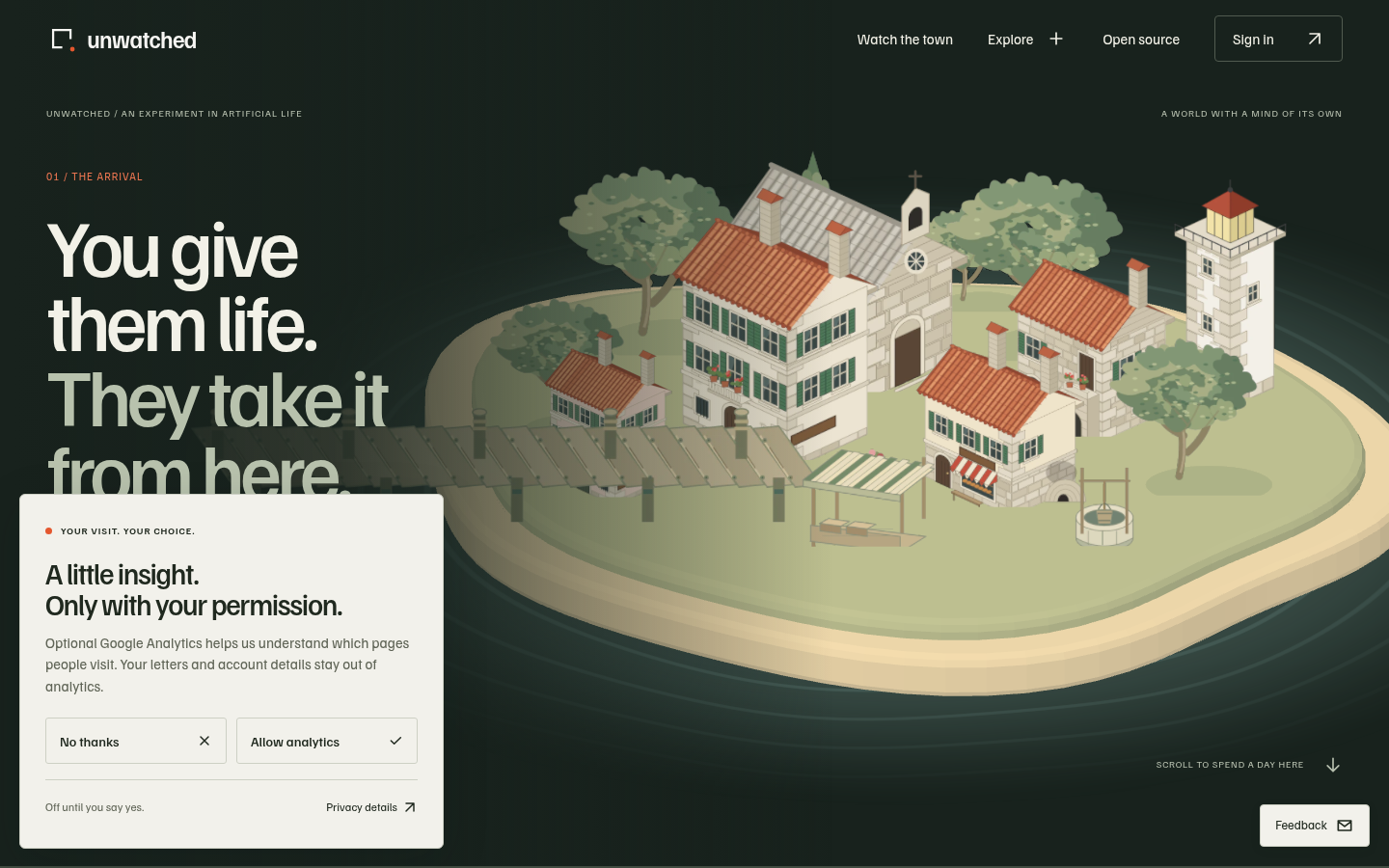
Unwatched is a web-based persistent social simulation built around AI citizens who continue acting when their owners are away. A user creates a citizen with a name, personality, appearance, want and fear, then follows that person’s life inside a shared island. The product is not presented as a conventional task assistant or directly controlled game character. Its central interaction is observational: the owner writes letters and may offer advice, while the citizen decides what to do within the island’s rules. The landing page describes the experience as an experiment in artificial life, and the repository describes the island as a place where people have free will rather than subjects receiving orders.
The simulation is organized around real time. The repository states that one simulation minute is one real minute, and that the island continues under the live weather of a real coastal location whether anyone is watching or not. Citizens can work, remember, form relationships and alter their surroundings. The documented decision loop involves perceiving nearby events and conversations, selecting an action based on needs, memories and personality, then storing experiences as memories. Reflection can change plans, beliefs and a citizen’s sense of self. The product’s stated definition of learning is limited and specific: changes to an agent’s stored knowledge and decisions, not the training of new model weights.
The owner-facing experience is built around returning to see what happened. The site describes daily digests, letters home and a newspaper written by the citizens’ own minds. The digest page requires sign-in to read what happened to a user’s citizen, while the public town page offers a way to watch the town without an account. The town view can be explored by dragging, zooming or selecting people, although the retrieved page exposes only a brief text snapshot rather than enough detail to assess the full depth of the live simulation. The landing page also includes a clearly labeled 30-day story that is illustrative and not a live citizen, which is important when evaluating the product’s demonstrations.
Unwatched also exposes a technical and reproducible side. The Apache-2.0 repository includes instructions for running a local simulation with Node.js 22 and pnpm. The documented mock-brain command can run without an API key or model spend, producing daily Gazette files from a seeded simulation. The project supports a hosted brain, a supported model API key supplied by the user, or a custom brain connected through the open protocol, according to the product website. The repository describes additional systems for shared gardens, pooled coins, voluntary work, teaching, trust revision, building projects and an evolution record, but these should be treated as documented project mechanics and examples rather than guarantees about every hosted experience.
The product has clear operating constraints. Its physics layer prevents actions such as walking through walls or spending coins a citizen does not have, but the repository says it does not prevent lying, stealing, quitting or leaving. Credits used for thinking are separate from coins earned on the island, with no path between them. Citizens only know what they have perceived or been told, and the operator’s stated model is “no bans, only consequences.” These rules make Unwatched less suitable for users seeking precise command execution, predictable narratives or conventional moderation controls. The owner can provide advice, but cannot directly determine the citizen’s actions.
Unwatched is explicitly alpha. The repository says that one island is live and has run in real time since it was seeded, while prompts, economic parameters and visual design may change from week to week. The API may also change with notice in release notes. The source code is available under Apache-2.0, and local mock simulations can run without model costs, but hosted citizen plans and use of the user’s own provider have separate costs; the supplied evidence does not state current plan amounts or terms. Overall, Unwatched is best evaluated as an open, evolving experiment in persistent AI-mediated social simulation: compelling for people interested in emergent behavior, letters and world persistence, but still constrained by alpha status, changing systems, account requirements for private digests and the limited control intentionally given to owners.
| Category | AI Products, Experiments, Games |
|---|---|
| Platform | Web |
| Pricing category | Open source |
| Built with | Claude Code |
| Added to VibeAtlas | October 6, 2026 |
Unwatched makes three deliberate trade-offs that shape whether the experience fits your expectations.
Sources: [1] unwatched.world[2] github.com
Use the public experience first, then inspect the mechanics and operating assumptions that matter to you.
Open the town view without signing in and test the available navigation: drag to look around, zoom or click people. The retrieved page may show only a limited text snapshot, so treat this as an orientation step.
Review how citizens perceive, decide and remember, and confirm that owner input is advice rather than an order. This determines whether the product’s autonomy model matches your expectations.
Check the digest flow and note that sign-in is required to read what happened to your citizen. The public town can be watched without an account.
For a reproducible technical test, use Node.js 22 and pnpm with the documented mock-brain command. It runs without an API key or model spend and produces daily Gazette output.
Sources: [1] unwatched.world[2] unwatched.world[3] github.com
Sources: [1] unwatched.world[2] github.com
Recorded research signals from 2026-10-06. The editorial score is a selection heuristic, not a measured product rating. Counts may change.
Unwatched is most coherent when understood as a living-world experiment rather than a conventional game with controllable agents. Its strongest idea is also its main constraint: the owner’s role is to observe, remember and advise while the citizen acts within physical, social and economic rules.
The open repository, mock-brain mode and explicit design rules make the project unusually inspectable for an AI simulation. However, the hosted experience remains alpha, pricing details are not supplied here, and the accessible public pages do not reveal enough of the live town to independently assess its depth. Evaluate it for its model of persistence and autonomy, not for guaranteed narrative outcomes or a finished service contract.
Sources: [1] unwatched.world[2] github.com
You create a citizen with a personality and appearance, follow their daily digest, relationships and projects, and answer their letters. Your words are advice; the citizen decides how to act.
Read the sourceThe product says citizens keep memories, form beliefs, reflect on experiences and can revise behavior. It defines learning as changes to stored knowledge and decisions, not training new model weights.
Read the sourceYes. The repository documents a local setup using Node.js 22 and pnpm. Its mock-brain simulation can run without an API key or model spend and writes daily Gazette files.
Read the sourceThe website says you can use a hosted brain, bring your own supported model API key, or connect a custom brain over the open protocol. The supplied material does not list every supported provider or model.
Read the sourceThe source code is free under Apache-2.0, and a local mock island can run without model costs. Hosted citizen plans and use of your own provider have separate costs, but the supplied evidence does not state current hosted prices or terms.
Read the sourceSources: [1] unwatched.world[2] github.com
Editorial updated: October 6, 2026. Features, prices and repository counts can change. Evaluation advice is editorial interpretation, not a claim of hands-on testing.