Murmur
Push-to-talk dictation for macOS using your own OpenAI API key
Claude Code
An installable AI skill that turns cultivation records, measurements, observations, and facility constraints into reviewable plans, calculations, incident workups, and operating records without claiming authority over consequential actions.
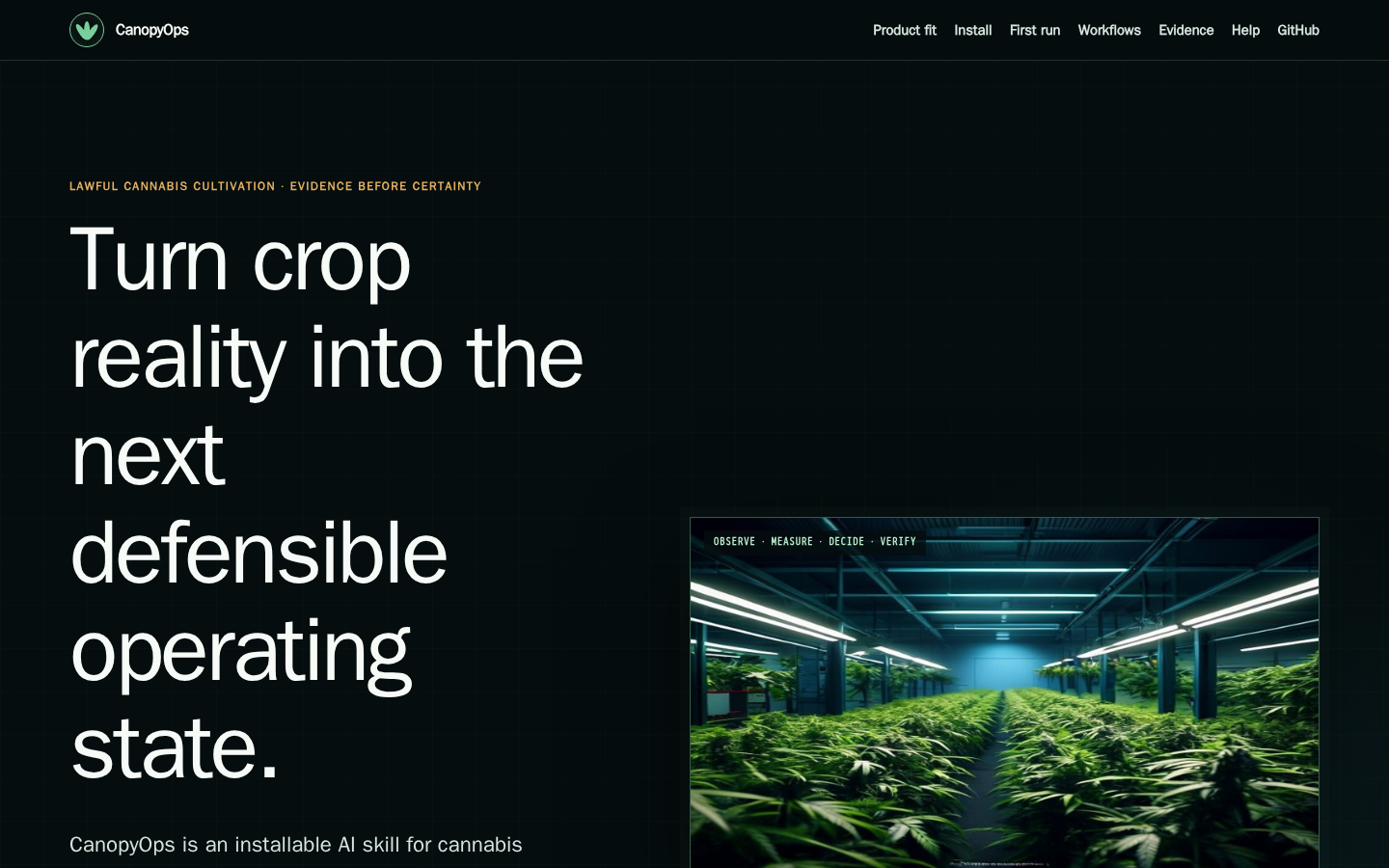
CanopyOps is an installable AI skill for lawful cannabis cultivation operations. It organizes room data, crop observations, facility constraints, logs, measurements, and unresolved questions into reviewable operating work. The documented output is advisory decision support rather than autonomous control: the skill can structure a crop plan, prepare an incident workup, reproduce a calculation, draft an operating record, or identify an approval gate, while leaving consequential authority with qualified people and governing procedures.
Its documented workflows cover crop and room planning, environmental and root-zone review, irrigation and quality incidents, pest and disease workups, harvest-readiness reviews, compliance-verification briefs, CAPA, risk registers, runbooks, crop walks, drying logs, cultivation decisions, and shift handoffs. CanopyOps works primarily with readable Markdown, CSV, and JSON artifacts, using included templates and schemas to preserve operational context. The documentation describes calculations for VPD, DLI, irrigation, runoff, dryback, EC, pH, and normalized units. These calculations are intended to be transparent and bounded by the supplied inputs, measurement methods, units, and assumptions.
A central operating constraint is the product’s evidence and authority model. CanopyOps separates observed, measured, calculated, assumed, interpreted, recommended, approved, executed, and verified states. A supplied target remains a comparison value until its source, crop stage, scope, tolerance, measurement method, and accountable approval establish it as an active target. Likewise, a polished recommendation does not become authorization. The product is designed to preserve uncertainty, competing explanations, evidence gaps, ownership, and reopen conditions rather than filling missing information with confident language.
The safety documentation places facility emergency procedures, approved labels and safety data, current statutes and regulators, facility SOPs, qualified laboratory evidence, equipment documentation, qualified professionals, and accountable humans above model output. CanopyOps does not control HVAC, irrigation, lighting, dosing, CO2, alarms, seed-to-sale, pesticide, laboratory, or batch-release systems. It does not authorize pesticides, setpoints, compliance filings, disposal, emergency actions, or batch release; it also does not claim to prove sensor accuracy, interpret law, validate laboratory methods, or guarantee field outcomes. Active life-safety or CO2 alarms must be handled through the facility’s emergency or evacuation procedure.
The repository documents two deliberately separate distribution lines. The repository-native source and plugin line is version 0.1.5 and is intended for direct GitHub marketplace installation, root source inspection, repository-native tests, and the branded plugin. The settled portable bundle is version 0.1.7 and includes Codex and Claude payloads, package-specific documentation, detached checksums, a manifest, a receipt, and a portable verifier. Users are instructed not to mix files between these lines. Static package validation establishes package structure, checksums, archive membership, or related custody; it does not establish fresh-host installation, host discovery, invocation, useful behavior, field fitness, or customer outcomes.
Builder evidence identifies Codex with GPT-5.6 as the tool used during OpenAI Build Week, with the project described as Collaborative Dynamics’ entry in Work & Productivity. The repository describes a routed skill, five operating workflows, deterministic Python utilities, templates, schemas, evaluations, host adapters, and a Codex plugin. It also records a 21-test deterministic suite and package-specific verification procedures. Those records support inspection of the supplied repository and artifacts, but the available evidence does not establish a field pilot, regulatory approval, production reliability, cultivation-hardware integration, independent customer outcomes, or commercial pricing. CanopyOps is therefore best evaluated as a specialized, human-governed operations and documentation layer for teams willing to validate installation, inputs, calculations, and decisions in their own environment.
| Category | AI Products, Developer Tools |
|---|---|
| Platform | Cross-platform |
| Pricing category | Not confirmed |
| Built with | Codex |
| Added to VibeAtlas | October 6, 2026 |
Three questions determine whether CanopyOps is relevant and responsibly usable in a cultivation environment.
Sources: [1] stunspot.github.io[2] github.com[3] github.com[4] github.com
The supplied documentation recommends separating package checks, host behavior, and operational usefulness.
Read the release status first, then select either the repository-native v0.1.5 route or the portable v0.1.7 bundle. Do not combine files, evidence, or version assumptions across the two lines.
For the portable bundle, extract it into a new directory and run the documented verifier. Continue only when it exits successfully, reports ok true, and has no findings. Repository-native checks have their own stated scope.
Install through the route matching the host, start a fresh task or conversation, and explicitly invoke CanopyOps if the host supports that behavior. Discovery must be observed separately from the quality of the resulting work.
Use the documented late-flower humidity-excursion style of scenario to inspect whether the skill requests missing context, preserves competing explanations, distinguishes containment from correction, and ends with a status such as provisional or awaiting authority.
Sources: [1] stunspot.github.io[2] github.com
The strongest fit depends on the team’s need for accountable records and its ability to validate every consequential decision.
Recorded research signals from 2026-10-05. The editorial score is a selection heuristic, not a measured product rating. Counts may change.
CanopyOps has a more specific operating model than a generic agricultural chatbot: it combines cultivation workflows, reproducible calculations, structured records, explicit evidence states, and approval boundaries. Its practical value should be assessed through a controlled installation and fictional or sanitized workup rather than inferred from package existence or documentation quality alone.
The central limitation is also clear. The supplied material does not establish live-host reliability, field validation, regulatory approval, hardware integration, customer outcomes, or pricing. Teams should treat CanopyOps as advisory decision support and documentation infrastructure, verify current authorities and measurements independently, and preserve accountable human review for every consequential action.
Sources: [1] github.com[2] github.com[3] github.com[4] github.com
CanopyOps is an installable AI skill for lawful cannabis cultivation operations. It structures room data, observations, measurements, facility constraints, and unresolved questions into reviewable plans, calculations, incident workups, CAPA, runbooks, harvest-readiness reviews, and handoffs.
Read the sourceNo. The safety documentation says CanopyOps does not issue actuator commands or claim integration with HVAC, irrigation, lighting, dosing, CO2, alarms, seed-to-sale, pesticide, laboratory, or batch-release systems.
Read the sourceThe project documents two separate lines: repository-native source and plugin v0.1.5, and a portable v0.1.7 bundle. The correct choice depends on the intended installation route, and the documentation says not to mix files from the two lines.
Read the sourceNo such validation is established by the supplied evidence. The documentation states that no field pilot, regulatory approval, legal opinion, pesticide authorization, batch-release authority, equipment integration, or production reliability claim is made.
Read the sourcePricing is not established in the supplied product site or repository materials. The appropriate pricing classification for this listing is therefore unknown.
Read the sourceSources: [1] stunspot.github.io[2] github.com[3] github.com[4] github.com[5] github.com
Editorial updated: October 6, 2026. Features, prices and repository counts can change. Evaluation advice is editorial interpretation, not a claim of hands-on testing.