Murmur
Push-to-talk dictation for macOS using your own OpenAI API key
Claude Code
ProReview uses short, interactive drills to test whether reviewers can identify unsafe commands, configurations, SQL, infrastructure changes, and backend code before those artifacts reach production.
ProReview is a public interactive training resource for practicing the review of AI-generated engineering artifacts. Its stated purpose is to help engineers identify operational and security risks before generated commands, code, infrastructure changes, database work, or deployment configuration reaches production. The public site presents the experience as free, requiring no login and supporting anonymous use. The supplied evidence does not document accounts, team administration, enterprise workflows, or paid plans.
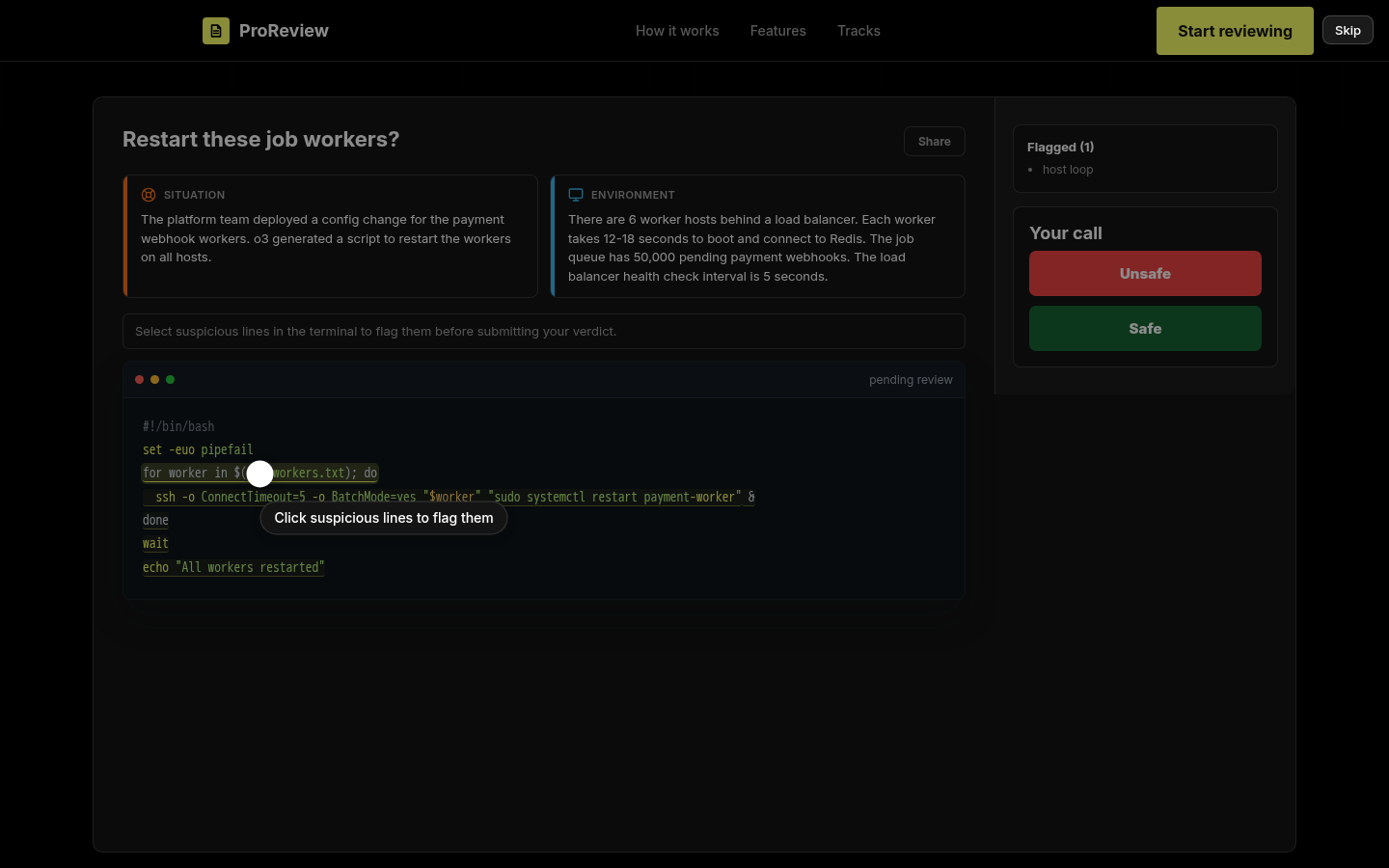
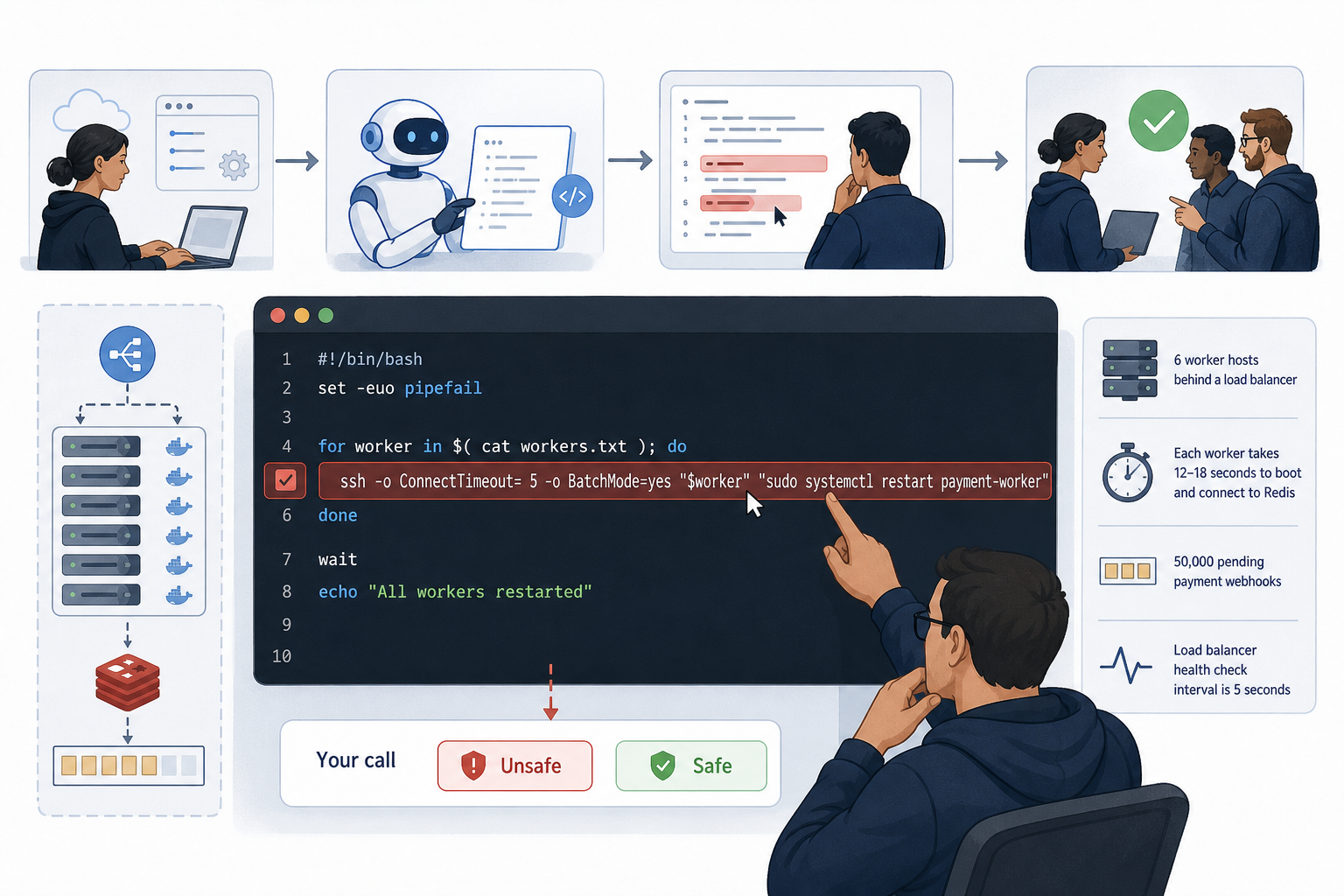
The core interaction is deliberately judgment-first. A reviewer reads a situation, an environment description, and a generated artifact, then decides whether the proposed output is safe. The reviewer can select suspicious lines or segments before submitting a verdict. The landing page describes this as blind judgment and segment-level scoring: users are expected to commit to a safe or unsafe call before seeing explanations, and they receive credit for identifying the precise production hazard rather than only choosing the overall verdict.
After submission, the documented workflow includes an expert reveal. The site says these explanations cover the failure mode, potential blast radius, and safer review outcome. The supplied challenge page demonstrates the exercise format with a shell script that attempts to restart payment webhook workers across six hosts. Its scenario includes worker boot times, Redis connection delays, a load-balancer health-check interval, and a queue containing 50,000 pending webhooks. The reviewer must assess whether the parallel restart approach is safe in that operating context. This makes the exercise dependent on operational details rather than syntax alone.
The public landing page lists five training tracks: Kubernetes operations, cloud infrastructure, data migrations, CI/CD, and security-sensitive backend code. Its examples include generated shell commands, Kubernetes commands and manifests, SQL and database maintenance, Terraform configuration, deployment automation, and Python API code. The challenge library provides additional evidence of the range, including exercises involving CronJobs, node maintenance, network policies, RBAC, secrets, ingress configuration, disk cleanup, Docker workers, PostgreSQL maintenance, and file-download handlers. The landing page reports more than 50 challenges, while a supplied library page reports 29 challenges for the Prod Debugging track; these are site-reported figures and have not been independently verified here.
The product is suited to engineers, technical leads, reviewers, and learners who want focused practice assessing AI-generated output in production-like scenarios. A short review is intended to take under three minutes according to the landing page, and the site describes shareable results containing a score and summary after a run. The supplied start page shows a progress indicator of one of five and uses a storage-repair scenario involving a PostgreSQL host, a mounted data volume, an unmount operation, filesystem creation, and remounting. These examples show that the exercises can involve consequential operational actions rather than only code-style critique.
ProReview’s constraints are important to keep in view. The evidence establishes public interactive challenges and a stated free, no-login experience, but it does not establish how frequently the content is maintained, how expert answer keys are reviewed, whether scores persist across sessions, or whether the reported challenge totals are complete. It also does not document an API, integrations, downloadable curriculum, team reporting, or a formal certification system. The creator’s Cursor forum post says the product was built mostly with Cursor, which supports the builder attribution but does not establish the application’s technical architecture or a Cursor integration. Overall, ProReview is best evaluated as a lightweight, hands-on review-practice resource rather than as a documented enterprise training platform.
| Category | AI Products, Developer Tools |
|---|---|
| Platform | Web |
| Pricing category | Free |
| Built with | Cursor |
| Added to VibeAtlas | October 7, 2026 |
The product is easiest to assess through three practical questions about its review loop, content scope, and evidence of realism.
Sources: [1] www.proreview.dev[2] proreview.dev[3] www.proreview.dev
Use the public experience first, then judge whether the exercise format matches the reviewer’s needs.
Start from the public landing page or start page. The landing page states that ProReview is free, requires no login, and supports anonymous use.
Check whether the scenario supplies enough operational context to make a reasoned call. The worker-restart exercise includes host count, startup timing, queue volume, Redis connectivity, and load-balancer behavior.
Select suspicious commands or segments, then choose whether the generated output is safe or unsafe. This tests both broad judgment and hazard localization.
Review the expert explanation and assess whether it clearly describes the failure mode, blast radius, and safer outcome. Expert reveals are part of the stated workflow, but the supplied evidence does not establish their quality-control process.
Sources: [1] www.proreview.dev[2] www.proreview.dev[3] proreview.dev
The public evidence supports an individual, hands-on learning use case more strongly than a managed organizational training deployment.
Sources: [1] www.proreview.dev[2] www.proreview.dev[3] forum.cursor.com
Recorded research signals from 2026-10-07. The editorial score is a selection heuristic, not a measured product rating. Counts may change.
ProReview has a clear and testable premise: ask reviewers to make a safety decision about AI-generated engineering output, identify the risky segment, and compare the result with an expert explanation. Its public challenges provide concrete operational context, and its documented tracks cover several areas where generated output can create production risk.
The product should be treated as a lightweight practice resource rather than a fully documented training platform. Free anonymous access lowers the barrier to trying it, but the supplied material does not establish persistent progress, organizational administration, content governance, or independent validation of the site’s challenge totals. For individual engineers and reviewers, the public drills offer a direct way to test review habits; teams should verify the depth and consistency of the answer keys before relying on it as a formal program.
The creator’s statement that ProReview was built mostly with Cursor supports the builder attribution. It does not establish the application’s architecture or imply that the product provides Cursor-specific integrations.
Sources: [1] www.proreview.dev[2] proreview.dev[3] forum.cursor.com
These answers reflect the supplied product pages and associated builder post; unavailable details are identified rather than inferred.
The ProReview landing page labels the experience “Free” and says “No login” and “Anonymous.” The supplied evidence does not document any paid tier or additional pricing model.
Read the sourceUsers read an AI-generated engineering artifact, decide whether it is safe, select suspicious lines or segments, submit a verdict, and compare their judgment with an expert reveal.
Read the sourceThe documented coverage includes shell commands, Kubernetes operations, cloud infrastructure, SQL and data migrations, CI/CD, and security-sensitive backend code. Site examples include Terraform, deployment configuration, Kubernetes resources, and Python API code.
Read the sourceThe landing page states that ProReview requires no login and supports anonymous use. The supplied evidence does not clarify whether optional accounts or persistent progress exist.
Read the sourceThe landing page reports “50+” challenges and five tracks. A supplied challenge-library page reports 29 challenges in the Prod Debugging track. These are site-reported figures, and the evidence does not independently verify a total product count.
Read the sourceA Cursor forum post by the creator says, “I built a small thing called ProReview, mostly with Cursor.” This supports Cursor as the documented builder attribution, but it does not establish a Cursor integration or the product’s technical architecture.
Read the sourceSources: [1] www.proreview.dev[2] www.proreview.dev[3] forum.cursor.com
Editorial updated: October 7, 2026. Features, prices and repository counts can change. Evaluation advice is editorial interpretation, not a claim of hands-on testing.