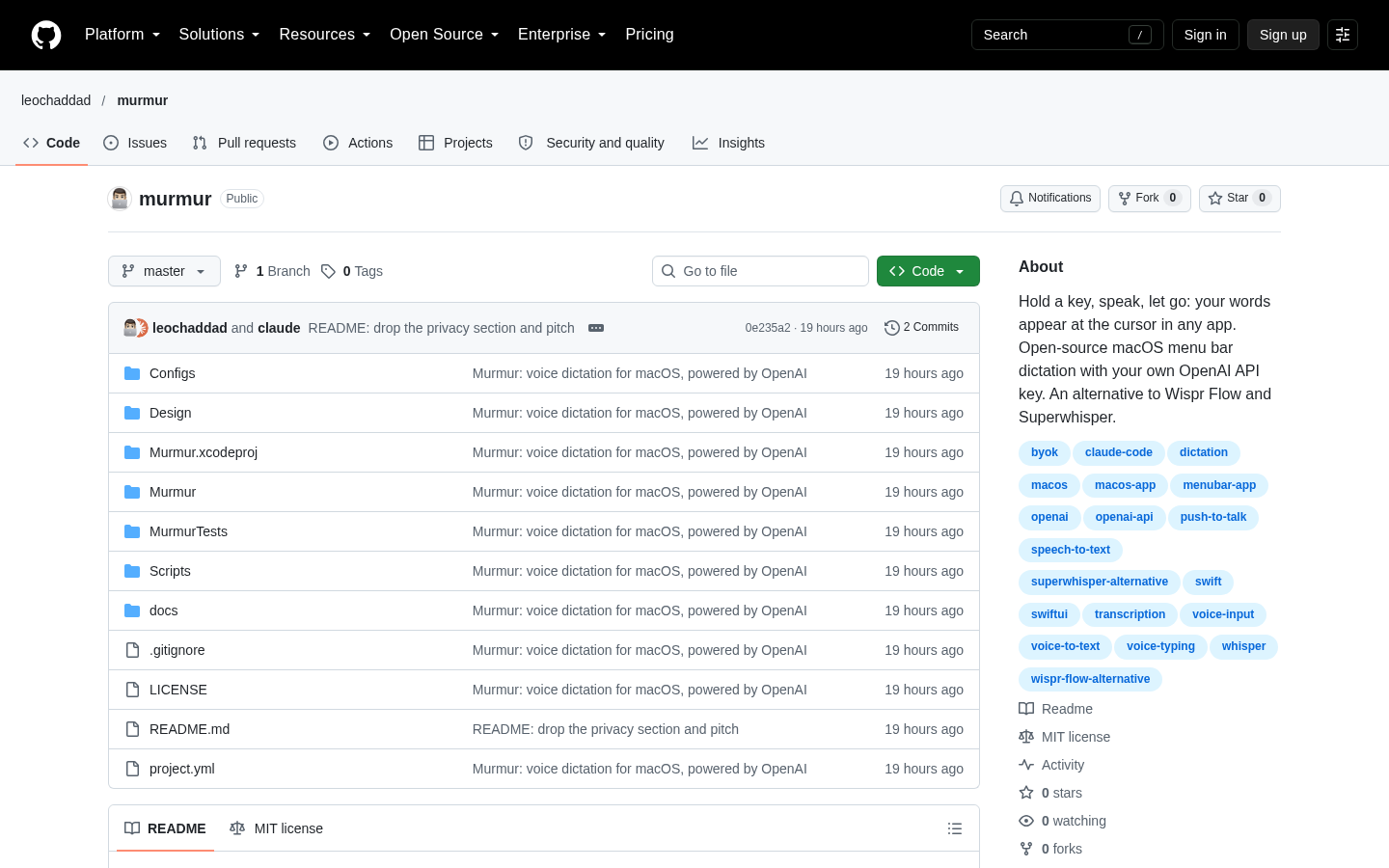
Murmur
Push-to-talk dictation for macOS using your own OpenAI API key
Claude Code
Scalex indexes Git-tracked Scala and Java source with AST-based analysis, giving coding agents structured navigation without compilation or a build server.
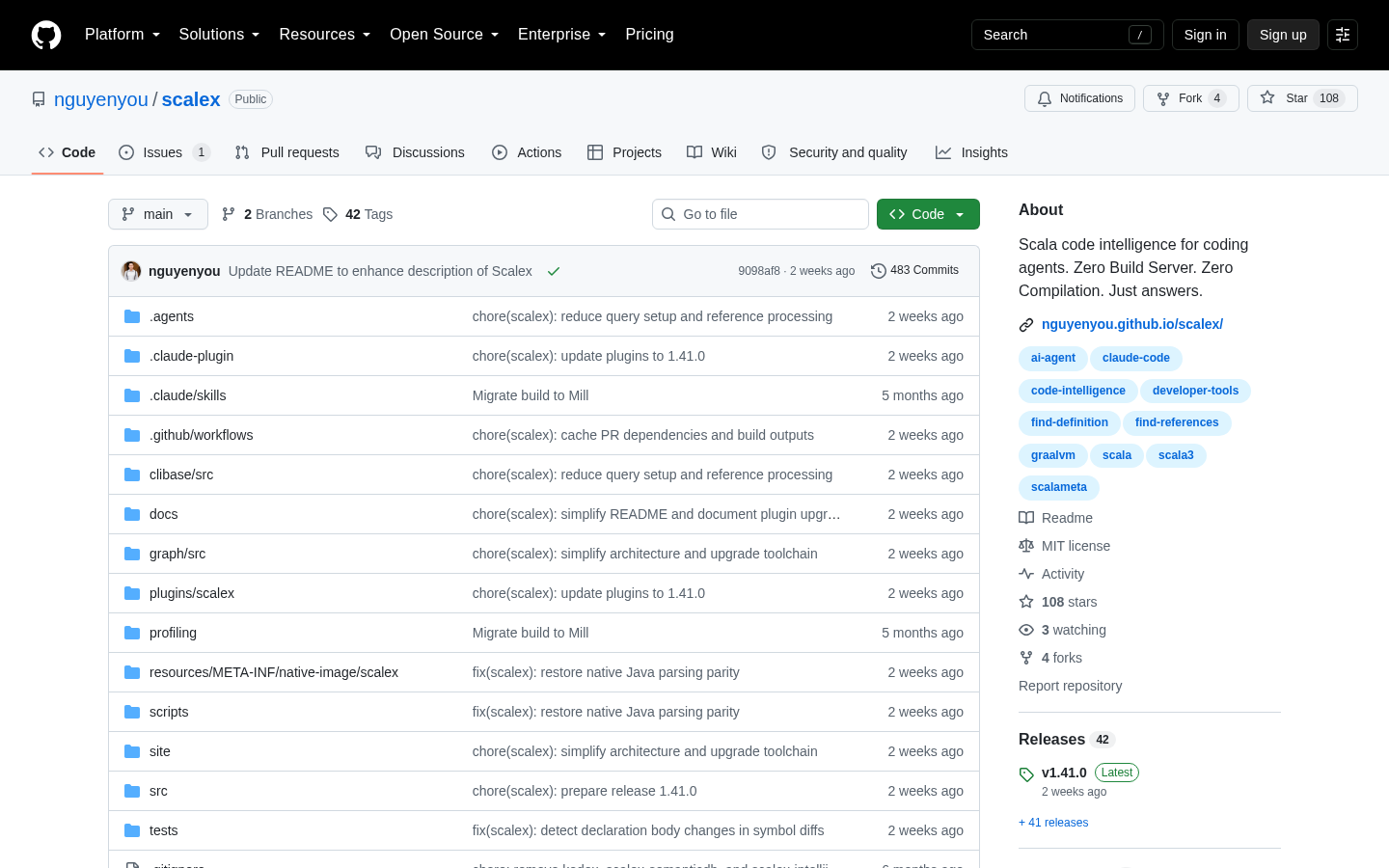
Scalex is an open-source developer tool for exploring Git-tracked Scala 2, Scala 3, and Java source code through coding agents. It analyzes source directly with abstract syntax tree parsing, allowing an agent to locate definitions, inspect types, find reference candidates, follow inheritance, examine imports, and read method bodies without compiling the repository or starting a build server. The project is designed for repository understanding rather than as a replacement for a compiler, language server, or refactoring engine.
The tool is distributed as a native executable with an agent skill and bootstrap script. The documented installation paths cover Claude Code and Codex CLI or desktop through plugin marketplaces. For other coding agents, the repository provides instructions for copying the shared skill, command reference, and binary bootstrap into an agent's skill directory. The bootstrap downloads a pinned release on first use, verifies its SHA-256 checksum, and caches the executable. The binary does not require a JVM at runtime, although the documented build process uses GraalVM and the repository's Mill launcher.
Scalex exposes commands intended to reduce the number of exploratory tool calls an agent needs. The `explain` operation combines a definition, documentation, members, implementations, and import information in one response. Other documented capabilities include symbol search, definitions, categorized reference candidates, inheritance hierarchies, wildcard-import resolution, package and annotation navigation, method-body extraction, batch queries, JSON output, result limits, and composable filters such as kind, path, test exclusion, exact matching, category, package scope, and maximum output. The plugin invokes a bundled CLI script rather than adding a `scalex` command to the user's PATH.
Its indexing model is based on Git-tracked files, Git object IDs, source parsing, binary indexes, and bloom filters. On a repository, Scalex identifies tracked files, compares cached object IDs, parses changed or new records, and stores repository data in a `.scalex/index.bin` file. Subsequent queries can reuse unchanged records, while batch queries share one index load. The README documents Scala parsing through Scalameta and Java parsing through JavaParser. It also describes a per-repository cache and a native executable, so there is no daemon or continuously running process to manage.
The project website presents performance measurements from a production monorepo and the Scala 3 compiler, including cold and warm indexing times, symbol counts, and query examples. These figures are project-published measurements rather than independently verified benchmarks. The site also describes import analysis, transitive hierarchy traversal, and query batching with example comparisons against grep. Those examples help explain the intended workflow, but they should not be treated as universal results for every repository, language feature, machine, or workload.
Scalex has explicit operating boundaries. It performs source-level analysis and does not provide compiler type resolution, verified test coverage, or rename refactoring. Reference results are candidates that can include comments or unrelated symbols with the same name, even though import information and confidence categories help narrow them. Test-related commands find mentions in test files rather than executed lines or verified assertions. Untracked files are excluded because indexing follows Git-tracked content, and unstaged edits can leave cached results stale; the documentation recommends checking fresh edits directly and using the `diff` command where appropriate. The documented supported platforms are macOS Apple Silicon, macOS Intel, and Linux x64. Pricing beyond the repository's open-source MIT license is not separately documented.
| Category | Developer Tools |
|---|---|
| Platform | Cross-platform |
| Pricing category | Open source |
| Built with | Claude Code |
| Added to VibeAtlas | September 30, 2026 |
The product is best understood through three practical questions: what it analyzes, how it integrates, and where its answers stop being authoritative.
Evaluate it against the repository conditions and agent workflow you actually use.
Check that Git is available and that the machine is macOS Apple Silicon, macOS Intel, or Linux x64. Confirm that the selected agent can load the documented plugin or copied skill.
Install through the Claude Code or Codex marketplace, or copy the shared skill for another agent. Use a Git-tracked Scala or Java repository and allow the bootstrap to download and verify the native binary on first use.
Ask the agent to locate a symbol, explain its role, show implementations, inspect a method body, and identify importers. Compare the returned locations with the source files you know are relevant.
Change a tracked file without committing, add an untracked file, and query references that share names with unrelated symbols. Check whether the index and candidate results fit your accuracy requirements.
Sources: [1] github.com
The strongest fit depends on whether fast source navigation matters more than compiler-backed semantic guarantees.
Sources: [1] github.com
Recorded research signals from 2026-09-29. The editorial score is a selection heuristic, not a measured product rating. Counts may change.
Scalex has a clearly bounded purpose: give coding agents structured, source-level access to Scala and Java repositories without requiring compilation or a build server. Its native distribution, Git-based cache, agent plugins, and commands for definitions, references, hierarchies, imports, bodies, and batch queries make the workflow concrete rather than conceptual.
The trade-off is equally concrete. Its results are not compiler-resolved facts, reference matches are candidates, cached indexes can lag behind edits, and untracked files are outside the index. The project is therefore best treated as a fast exploration and context-gathering tool that complements grep, a compiler, or Metals—not as a complete semantic IDE substitute. The evidence establishes open-source MIT licensing and documented macOS and Linux support, but does not establish a separate commercial pricing plan.
The documentation says Scalex supports source navigation for Scala 2, Scala 3, and Java. It uses Scalameta for Scala parsing and JavaParser for Java parsing.
Read the sourceNo. Scalex parses source directly and is documented for repository exploration without compiling the project or starting a build server.
Read the sourceThe README provides plugin installation commands for Claude Code and Codex CLI or desktop. It also documents copying the shared skill into another agent's skill directory. Cursor is discussed on the landing page, but a dedicated installation procedure for Cursor is not established by the supplied material.
Read the sourceNo. References are candidates based on source matching and import-related confidence. Results can include comments or unrelated symbols with the same name, so compiler-backed verification may still be required.
Read the sourceUntracked files are absent because indexing follows Git-tracked files. Unstaged edits can leave the cached index stale; the documentation recommends verifying fresh edits directly, and says that diff reads current source directly.
Read the sourceThe landing page and repository README identify Scalex as open source and MIT licensed. No separate paid plan or commercial pricing is documented in the supplied material.
Read the sourceEditorial updated: September 30, 2026. Features, prices and repository counts can change. Evaluation advice is editorial interpretation, not a claim of hands-on testing.