Murmur
Push-to-talk dictation for macOS using your own OpenAI API key
Claude Code
Skillbridge converts a candidate’s target role into an AI-generated gap analysis, assessment, phased learning plan, and public progress profile, with a demonstration workflow for company sponsorship.
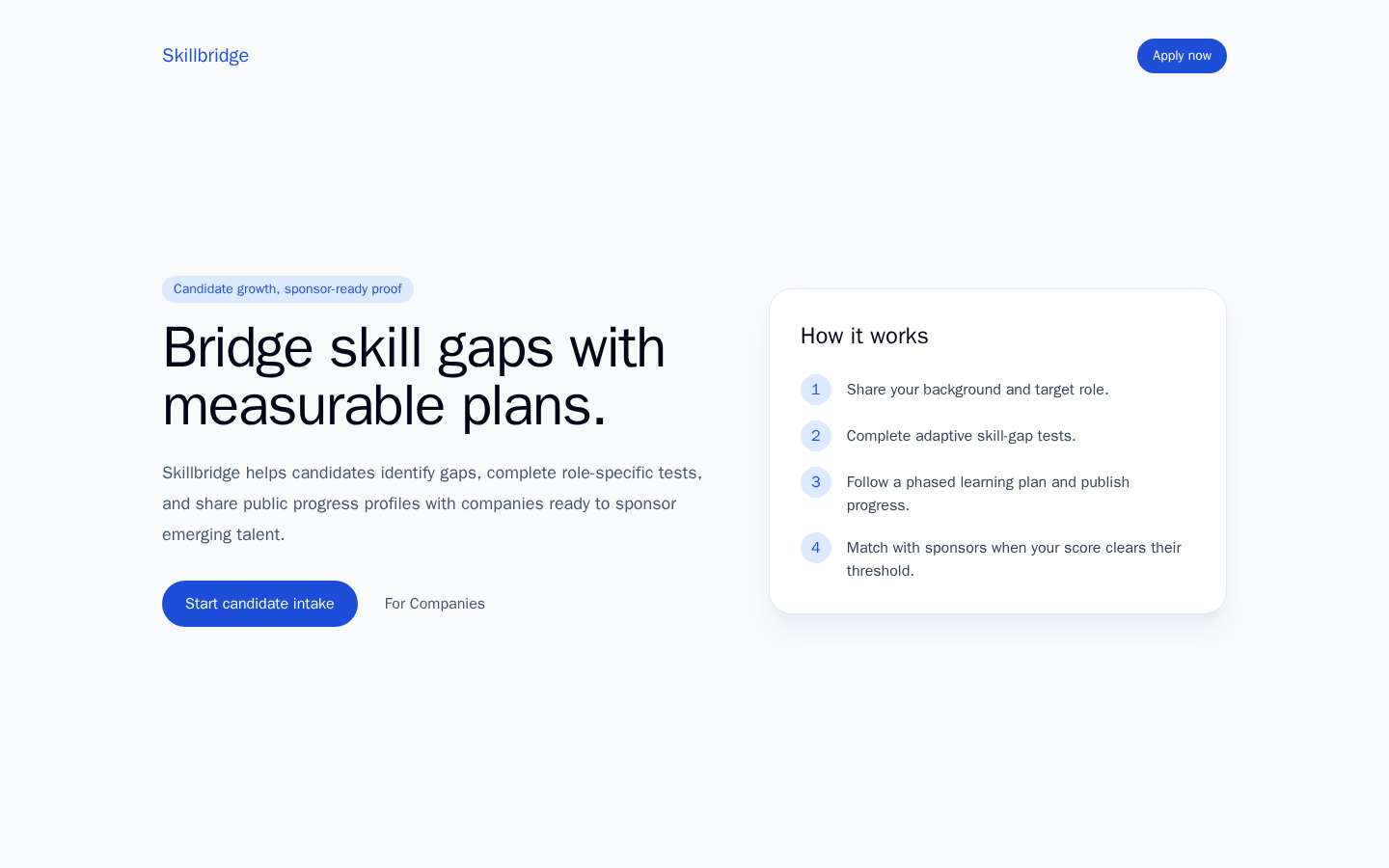
Skillbridge is a web-based hackathon prototype designed to turn a job seeker’s target role into a structured development journey. A candidate begins by describing their experience, skills, and intended role in free text. The application uses the OpenAI API to convert that material into structured current skills and skill gaps. It then generates a role-specific assessment, scores the submitted answers, and creates a phased learning plan. The public website summarizes the proposition as helping candidates identify gaps, complete adaptive tests, publish progress, and connect with potential sponsors.
The documented candidate workflow spans intake, assessment, planning, and progress reporting. According to the repository, each adaptive test contains five to eight questions calibrated to the candidate’s identified gaps. After scoring, the system creates a roadmap containing three to five phases, with each phase covering a skill focus, learning resources, and a checkpoint task. Candidates can mark phases as complete, while a milestone bar displays overall progress at 25, 50, 75, and 100 percent. This produces a concrete sequence rather than an unrestricted AI coaching conversation, although the supplied evidence does not describe how the generated resources are validated or how assessment quality is reviewed by human experts.
A shareable achievement page makes the candidate’s progress, milestones, and sponsorship status public. The repository also documents a cheer or like counter on this profile. On the company side, organizations can submit contact information and target roles through a registration form. A lightweight administrative screen is used to approve companies before they appear publicly. Approved companies can view candidates whose target role and test score correspond to their stated needs, accompanied by an AI-generated one-line fit summary. A sponsor action then records a sponsorship and adds a badge to the candidate’s public page.
Skillbridge is implemented with Next.js 14, TypeScript, Tailwind CSS, Supabase, the OpenAI API, and Vercel. Its repository attributes the project structure, Supabase migrations, API routes, and interface components to ChatGPT Codex work conducted across roughly 15 or more sequential tasks. Runtime AI is documented for profile analysis, test generation, answer scoring, learning-plan generation, and company-facing fit summaries. The database migrations cover candidates, skill gaps, tests, plans, progress, companies, and sponsorships. Local deployment requires Supabase credentials, including a service-role key, plus an OpenAI API key, and the migrations must be applied in chronological order.
The present implementation has substantial operating constraints. Candidates do not have accounts, and their profiles are accessed by ID without ownership checks or duplicate-submission protection. Company registration has no login or session system, so anyone can act as an approved company in the demonstration dashboard. The administrative approval page is also unauthenticated. Supabase Row Level Security has not been configured, with public read paths instead relying on server-side service-role queries. Sponsorship is not a payment feature: the displayed $500 amount is a fixed placeholder, and the repository documents no real transaction flow. Pricing, a finalized software license, named team information, and a completed Codex session reference are not supplied.
For evaluation purposes, Skillbridge is best understood as an AI-product experiment demonstrating an end-to-end candidate-development and sponsorship concept, not as a production employment, credentialing, or funding platform. Its strongest element is the visible chain from stated career goal to assessed gaps, phased work, public evidence of progress, and sponsor-facing discovery. Prospective evaluators should test the relevance of generated questions and plans while using non-sensitive sample information. Production adoption would require authentication, authorization, ownership enforcement, Row Level Security policies, privacy controls, assessment validation, and a genuine payment or sponsorship process. Claims that the complete workflow is live and tested end to end come from the project repository and are not independently corroborated by the supplied material.

| Category | AI Products, Experiments |
|---|---|
| Platform | Web |
| Pricing category | Not confirmed |
| Built with | Codex |
| Added to VibeAtlas | September 25, 2026 |
Skillbridge is easiest to assess by examining the candidate journey, the sponsor loop, and the safeguards still missing from the prototype.
Sources: [1] github.com[2] skillbridge-delta-three.vercel.app
Use sample information and focus on the quality and continuity of the demonstrated workflow.
Describe sample experience, skills, and a target role, then inspect whether the structured gap analysis accurately reflects the supplied background.
Check whether the generated five-to-eight-question test is relevant to the target role and identified gaps. The supplied evidence does not document independent assessment validation.
Evaluate whether its three to five phases, resources, and checkpoint tasks form a coherent and realistic learning sequence.
Confirm how progress appears on the public candidate page and how a company sees matches, fit summaries, sponsor actions, and the resulting badge.
Treat all authentication, authorization, privacy, database-policy, and payment behavior as prototype work until the documented limitations are resolved.
Sources: [1] github.com[2] skillbridge-delta-three.vercel.app
Sources: [1] github.com
Recorded research signals from 2026-09-25. The editorial score is a selection heuristic, not a measured product rating. Counts may change.
Skillbridge presents a notably complete conceptual loop: identify a role, diagnose gaps, test relevant knowledge, create a phased plan, publish progress, and expose that progress to potential sponsors. The repository provides concrete routes, data entities, runtime AI uses, and build attribution rather than relying only on a high-level product claim.
The same documentation makes clear that it should remain a demonstration environment. Authentication, authorization, privacy controls, database policies, validated assessment methods, and real sponsorship transactions would all need substantive work before production use. Its value today is as an inspectable AI-product experiment rather than a trusted employment, credentialing, or funding service.
Sources: [1] github.com[2] skillbridge-delta-three.vercel.app
It documents a structured skill-gap analysis, a five-to-eight-question role-specific test, automated scoring, and a three-to-five-phase learning plan containing skill focuses, resources, and checkpoint tasks.
Read the sourceYes. The repository describes a shareable public achievement profile showing progress, milestones, a cheer or like counter, and any recorded sponsorship badge.
Read the sourceCompanies see public candidates whose target role and test scores match their needs, along with an AI-generated one-line fit summary. The supplied material does not document a more extensive ranking or recommendation methodology.
Read the sourceNo real payment flow is documented. The repository identifies the $500 sponsorship amount as a fixed placeholder used by the prototype.
Read the sourceNo. The documented prototype has no candidate accounts, company login or session system, ownership checks, protected administration, or configured Supabase Row Level Security.
Read the sourceThe supplied sources do not establish product pricing. The repository’s license section is an unfinished placeholder, so no finalized software license can be stated.
Read the sourceSources: [1] github.com[2] skillbridge-delta-three.vercel.app
Editorial updated: September 25, 2026. Features, prices and repository counts can change. Evaluation advice is editorial interpretation, not a claim of hands-on testing.