Murmur
Push-to-talk dictation for macOS using your own OpenAI API key
Claude Code
A card you build and bring to events, so the people you meet there have something to keep instead of trying to remember your name.
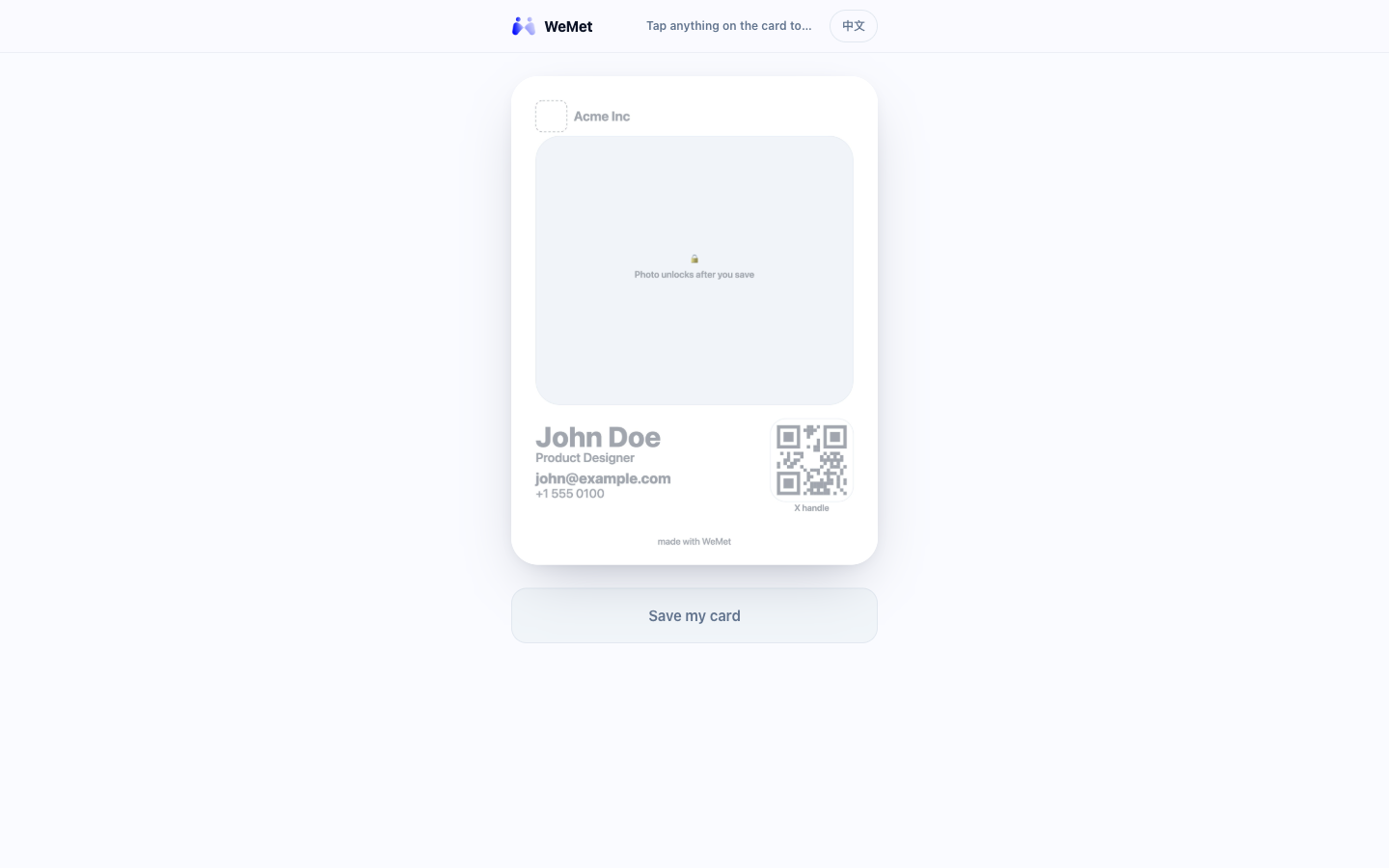
WeMet is a small web app for making a personal card you can show or send to people you meet at conferences and social events. The product is deliberately minimal, and the whole thing fits on one screen: a card you edit in place, a photo you can reposition, and a save action.
Editing works by tapping the card directly rather than filling in a separate form. Every element on the card is editable in position, which keeps the interaction close to the object you are making. Photos are handled with a drag-to-adjust crop, so you can set how the image sits inside the card frame without a separate cropping tool. From there you save your card, and the app supports keeping more than one, with a new-card action available once you have saved the first.
The recovery model is the most distinctive detail. Cards can be saved and restored through codes, including a text-only restore code that recovers everything except the logo, in which case the app directs you to recover it from the restore image instead. That is a persistence design built around sharing rather than around an account: the card is a portable artifact, and losing your session does not necessarily mean losing the card. Signing in with Google is offered as the way to keep a card connected to an account, which suggests cards are otherwise stored locally in the browser rather than on a server, though the app does not document its storage model explicitly.
The interface is bilingual, with an English and 中文 toggle, and it is built mobile-first: the viewport is configured with viewport-fit=cover for phones with notches or home indicators, and the layout is a single column sized to a phone screen. There are no marketing pages, no pricing, no changelog, and no explanation of what the product is beyond the app itself.
The origin story comes from its launch. On 13 August 2026, @damonchen posted that @MENSO_Liu had vibe coded the app in a traffic jam on the way to meet Marc Lou, that it was now live, and that the intended use is bringing it to a conference or social event so the people you meet do not forget you. That post is the only source reviewed for how the app was made; the build tool is not named in it, so this listing attributes the maker without claiming a specific AI builder.
What is verifiable today is the behaviour of the app: in-place card editing, drag-to-crop photos, multiple saved cards, text-only restore codes with a separate restore image, Google sign-in for account-linked cards, and an English and Chinese interface on a phone-first layout. What is not documented anywhere is adoption, how many cards have been created, whether there is any sharing or analytics layer, and what happens to a card if you clear your browser without signing in. For a reader, this is a weekend-scale experiment with one clear use case, best judged by opening it on a phone and building a card before an event.
| Category | Experiments |
|---|---|
| Platform | Web |
| Pricing category | Free |
| Built with | Not documented |
| Added to VibeAtlas | September 11, 2026 |
A card you build and bring to events, so the people you meet there have something to keep instead of trying to remember your name.
Read the sourceUse the official product link below. It is the destination recorded for this listing.
Read the sourceCheck the current product page before making a decision. The directory's pricing category is a listing field, not a live price quote or availability guarantee.
Read the sourceThe VibeAtlas listing credits Other AI tools as the build tool behind WeMet.
Read the sourceThe VibeAtlas listing records WeMet as free to use. Check the product page for any optional paid options.
Read the sourceThis page uses the information supplied with the listing. Features, prices and repository counts can change. Evaluation advice is editorial interpretation, not a claim of hands-on testing.